



3 min read

The physical backbone of modern data centers is always active, carrying the constant demands of power, cooling, and computation. Service outages are often discussed in terms of software or network failures, but the physical layer is just as critical. Power distribution systems, cooling infrastructure, electrical busways, and rack-mounted hardware are assembled using tens of thousands of fasteners, each one a potential point of resistance, heat generation, or long-term degradation if installed inconsistently.
 The rise of artificial intelligence has only intensified this challenge. Higher power densities, increased cooling demands, and tighter packaging leave virtually no margin for mechanical error. Even small deviations in fastening, incorrect torque, inconsistent depth, or improper angle, can lead to shorts, hot spots, thermal runaway, and unplanned downtime across an entire facility.
Given the requirement for continuous operation, there is no room for variability in data center fastening processes. Small errors don’t remain isolated; they multiply across thousands of fasteners, creating inevitable points of failure. In this environment, fastening consistency is not a preference; it is a requirement.
One Loose Fastener Away:
Why Data Center Power Demands Zero Variability
As power flows through a data center, from the grid or backup generators, through UPS systems and PDUs, into busways and down to individual racks packed with sensitive electronics, significant electrical loads generate substantial heat. Supporting these systems is a complex cooling ecosystem, ranging from component-level heat sinks and in-row cooling to facility-wide thermal management systems. All of these elements must work in concert to maintain reliable, efficient operation.
In this environment, joint quality is not optional. Any deviation in torque, depth, or angle of rotation introduces risk to the entire system. What makes this especially dangerous is scale: across vast server networks, a minor issue in a single joint can cascade into a facility-wide failure.
 The consequences rarely stay local. Modern data centers support global workloads, from AI inference and image generation to financial transactions and emergency services. When a failure occurs, performance degrades, outages follow, and access to critical data is disrupted, triggering a chain reaction that erodes customer confidence and trust.
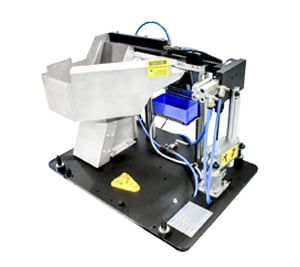
Automated screwdriving mitigates (and often eliminates) these risks. High-precision, tight-tolerance systems deliver repeatable fastening while capturing process data for traceability. Torque, angle of rotation, and final drive depth are monitored and controlled throughout the assembly process, ensuring every fastener is installed to the same specification, every time.
Taking the Guesswork Out of High-Stakes Assembly Work
“Good enough” has no place in data center construction. When uptime is the priority, every joint must meet exacting standards, because the weakest link will ultimately define system reliability.
This is where three-dimensional automated fastening becomes essential. WEBER screwdriving systems control torque, angle of rotation, and depth throughout every drive cycle, delivering consistent clamp load on every joint. The result is reliable electrical connections, uniform heat transfer, and full traceability across the entire infrastructure.
Traceability adds another critical layer of protection. If an issue does arise, technicians can review fastening data by location and cycle, enabling faster root-cause analysis before invasive teardown begins. Identifying problems early and precisely reduces downtime, limits disruption, and shortens repair cycles.
Automation also addresses the realities of modern manufacturing. Fastener-heavy assemblies are difficult to scale using manual labor alone, and even highly skilled technicians introduce natural variability over time. Automated screwdriving reduces dependence on scarce skilled labor while enabling consistent quality at scale. Just as importantly, automated systems allow manufacturers to retool and expand production quickly as demand shifts, an increasingly important capability in a rapidly evolving data center market.
Automated screwdriving provides the foundation for building data center infrastructure with greater consistency, repeatability, and scalability.
As digital and AI-driven workloads continue to grow worldwide, automated fastening will play an increasingly critical role in ensuring the uptime, reliability, and performance of modern data centers demand.